
The World Building Blog
-
How this site uses AI
In my day job, I advise university students on using AI in their studies. I’m fully aware that I am both a user and a moderator of generative AI. Understanding AI’s capabilities is one of the reasons I use it. While I have found AI to be quite powerful, the limitations and edge cases become apparent only when I’ve used it under real conditions.
Writing
In my own writing, I use AI as a copy editor. I have always struggled with grammar, so I’m always looking for a more advanced spell-checker. It’s not only about pinpointing technical errors; I also need something that can patiently explain why I’m mistaken. If I can learn from my mistakes, I can attempt to correct them myself. My preferred tool for this purpose is Grammarly. Its “Improve It” function is something I’ve struggled with. It has just enough editorial correction without losing my voice. That’s not to say I always accept its recommendations. With a site like this, I’ll often want a particular turn of phrase or expression that it doesn’t always like.
I use generative text AI sparingly. I’ve generally found two use cases:
- Real World Profiles: I create factual entries for real-world characters, such as various Mongol Khans or Crusader figures, because their histories intersect with certain fictional characters. This helps me maintain an accurate timeline. I draft short biographies of those figures to ensure their interactions with fictional characters feel authentic. Typically, I write the timeline entries for a particular character first. Then, I use tools like Google’s Gemini or Open AI’s ChatGBT to develop more detailed profiles based on my initial text and relevant timeline events information. The process begins with my notes and outlines, which the AI then expands into a more coherent format. After that, I always take the time to polish and rewrite anything generated to align with my vision. Essentially, I use these tools to refine specific aspects that I may not be as focused on finishing.
- The N-th Profile. The second way is similar in that it involves filling gaps. In one or two cases, I’ve written profiles and backgrounds for, say, three of the characters involved in an event, but I still need to write profiles for one or two more characters. That can be a real drag, as there is no new information in those additional profiles, just slight variations in perspective. I’ve experimented with giving AI the first three profiles and then asking them to write the additional ones. As with the factual entries, I found that this gives me a draft that is good enough to accelerate my workflow, leaving me with time to concentrate on individualising those narratives rather than recapitulating the shared content.
Coding
This website is run on WordPress. I have written and maintained WordPress sites and themes since it started over 20 years ago. I’ve been down the rabbit hole on PHP, semantic HTML, and even a significant amount of typography theory. Sometimes, I spent more time developing the backend of my old site rather than producing content. Those days are gone; nowadays, I want to get the job done and concentrate on content.
Anthropic’s Claude AI has generated almost all of the code in this current WordPress theme. However, there has been a learning curve attached to that. I have learnt that I only trust AI-generated code to do things I could code myself otherwise. I describe the architecture of what I want and specify a detailed breakdown of methods and functionality, but I stop short of providing pseudo-code. I then get the AI to generate the code based on that. I audit and test the code thoroughly before deploying. This is essential as AI makes mistakes and will even admit to them if you challenge it. I could write all that code from scratch, but this way, I get to use AI as a force multiplier — significant features can be added in a few hours rather than taking all weekend.
Observation: In the WordPress ecosystem, AI-written plugins will pose a significant challenge to commercial plugins. If you want a particular feature without all the bells and whistles, you can easily code that up with AI assistance—case in point. I wanted a grid of posts — the almost universal grid of images with snippets of text overlaid on top. Some excellent commercial plugins would achieve that. However, they also achieve 1000 other permutations that I don’t need. I could write it myself, but it would take me a few days to figure out what WordPress’s current API is. Instead, I specified exactly what I wanted, and Claude generated all the necessary files in about 60 seconds. Some refinement and polishing were required, but I had what I needed. For me, AI now kills the need for skilled amateurs to use commercial plugins. I won’t release what I created because I don’t want the hassle of maintaining the code. However, it will be interesting to see what happens when AI-written plugins start making their way into the repositories.
Imagery
The most obvious use of AI on this site is imagery. AI-generated images accompany most profiles and posts. This started with me using AI as a “concept” artist. I found it easier to give a backstory or purpose to a character that I had a representation of. Black Forest Lab’s Flux text-to-image AI is a type of AI that takes in quite long and descriptive prompts, and I find drafting those to be instructive in developing the character myself. However, I also find that it’s like a casting call. You generate 10 images and then go, “that one, number seven, that’s the one I had in my mind”.
Unlike working with a real breathing artist, you don’t always get what you want. At the moment, I’d liken AI imagery to the “Bob Ross” style of painting — it gets interesting when you get “happy accidents.” These are things you didn’t prompt for, but inspire some new ideas or a flurry of writing. Without that unexpected flash, the AI images are just endless stock images. Sometimes you get what you need or what you can work with, but it’s very rare to get exactly what you want.
-
Rise of the Old Ones (rock song)

I make no secret that a lot of the imagery I use on this site is AI-generated, albeit with a lot of finesse on the prompting and some judicious Photoshop post-work. However, I never really had much faith in AI music. That was until I saw Theoretically Media’s post on Riffusion, an AI service that can create full 3-4 minute songs with lyrics. I played around with giving it some of the Atlantis backstory, Orin Atlaneas versus Ichthultu, that I’d recently been working on. The results are impressive. My two favourites of my initial experimentations are:
- Son of Atlan – “1980s hard rock, driving rhythm, epic metal” describing Orin (the Son of Atlan) and his fight against the “Terror from the ancient deep.
- The Burden of the Atlanteans – “1980s hard rock, epic riffs, anthemic choruses” describing the ancient weight of the cursed Atlanteans.
Taking it further, I gave ChatGBT the overall story and asked it to create lyrics for an Iron Maiden/Metallic style epic on the fall of the Old One. I then took those lyrics and gave them to Riffusion to create this one:
- Rise of the Old Ones – “1980s hard rock, arena-filling power chords, wailing vocals, anthemic choruses” – the exile of the Atlanteans and the victory of Orin.
I may be betraying my taste with those prompts, but it’s odd hearing your own version of plots turned into quite good guitar epics.
-
Questions about Hyperborea and Atlantis?
“There have been an awful lot of Atlantises, will be quite a few more.” — Books of Magic #1 by Neil Gaiman and John Bolton.
How many ancient civilisations?
DC Comics has a vast number of ancient civilisations that should have been present on Earth simultaneously. However, very little interaction is seen between them. Turning them into a cultural set plays off some of the backstory to Seven Soldiers, where Grant Morrison refers to an uplifted set of humans living in four cities named after the mythical origin cities of the Tuatha De Danann (the “Tribe of the Gods” in Irish folklore). The cities are called Falias, Gorias, Finias, and Murias, and they correspond to the north, east, south, and west cardinal directions. My contention is to map these onto pre-existing DC fictional cities.
The inhabitants of these cities are the Old Ones. I used various names, but it’s crucial to avoid any racist connotations, so I opted for a more generic term. I intended for them to symbolize all of humanity. At this point in the Middle Paleolithic, it’s likely they would predominantly have dark skin. I find the notion of a time traveller facing a significant culture shock against their preconceptions truly fascinating. Although some of their descendants might eventually become light-skinned, that change would occur entirely independently of the mutations that led to the emergence of Europeans and Asians.
Falias, City of the North

Lansinar, the City of the North Wind, is contained beneath the Auroral Curtin. The North City is Lansinar. This city is from an old Hawkman story and a later John Byrne Wonder Woman story (DC Database: Lansinarians). It is pretty much your stereotypical high-tech lost ancient city, albeit it has animal-headed inhabitants (something I quietly ignore until another time). There must be over a dozen of these buried in DC Golden Age and Silver Age stories, so I decided to go with this one.
The Arctic environment matches the North for Falias, and it serves as our Hyperborea. To the Greeks, Hyperborea was a fabled northern land of eternal spring where blessed people lived. I almost went with the name Hyperborea, but I am less than impressed by some other folk who use that old Greek myth, so I decided to stick with a DC name.
Finias, City of the South

Z’onn Z’orr, the Capital City of Le’Muria, is enriched by the Mountains of Madness. If Lansinar is our Falias/Hyperborea then Finias, the City of the South, is Z’onn Z’orr, the White Martian city from Morrison’s “Hyperclan” arc of JLA. I’d already alighted on it as a proxy for Lovecraft’s city from At the Mountains of Madness, so it made an interesting addition.
It is the capital of a client empire called Le’Muria, our source for as many genetically engineered near-human ancient races as we need – including the Ophidian Serpent Men (another Conan reference) and the Dyzan (from Young All-Stars).
Gorias, City of the East

Shambhala, the Timeless Land containing the Nanda Parbat monastery. Fitting this in was challenging since I haven’t given much thought to the Sphere of the DC Universe. The concept involves a mystical, timeless eastern land, which in DC typically leads to Nanda Parbat. There are many actual and fictional names associated with it, so I decided to say that the monastery of Nanda Parbat overlooks the valley of Shambhala. Additionally, I’ve noted that Rama Kushna is one of the New Gods and resides in the timeless valley because she was mortally wounded and would die if she were to leave.
Murias, City of the West
The last city is, as they say, a no-brainer; this has to be Atlantis, but that raises a further question
Which Atlantis?
What is Atlantis in the DC Universe? This is one of the questions that caused problems early in DC Comics history- virtually every major hero in the DC Universe visited Atlantis or some proxy during the Golden and Silver Ages. Yet, every single “Atlantis” was different from each other and distinct from the “main” Atlantis shown in the Aquaman comics.
Even in the Comics Bronze Age (1970/80s), there were multiple versions of Atlantis. There was the ancient version from Arion, and it’s odd Robert E. Howard dating, there were merpeople from the Superman comics, the version from Aquaman, and whatever version the Gem World was pulling from. As the Books of Magic comment above illustrates, there were multiple consecutive versions of Atlantis. There are even alternate versions of Atlantis from the DCAU and the DCEU — the cartoon and movie universes.
The Four Atlantises
So, how do we handle this? I have chosen to split Atlantis into four periods, each based on a different DC source and giving a different diaspora after its fall.
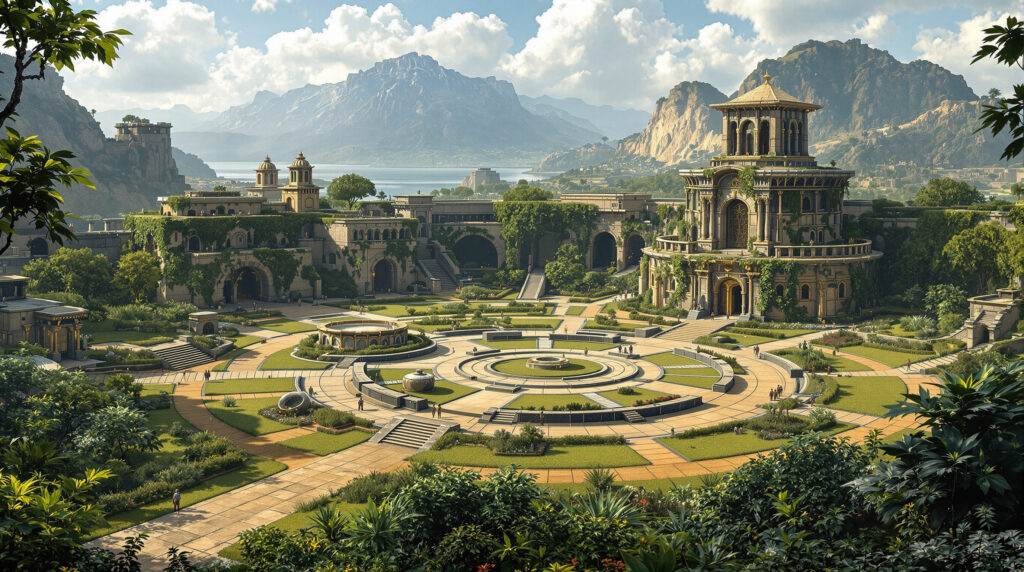
The Royal Precinct in the Old City of Atlantis shows the Tomb of Cleito and its outlook on Mount Evanor. The first Atlantis earliest is the fantastic Atlantis, the Elder City, which is more myth than anything else. This is the Atlantis that was founded by the children of King Atlan and was one of the four Eldar Cities — another element of our growing mythos. — that existed in the Lansinarian Age (our Hyperborean Age) and is the dark ancient city that always haunts the later versions.
This is the version that worshipped a Lovecraftian god; it’s the version whose sorcerer-kings became the gods of future centuries; and it’s the version that took part in the Universe War against Apokolips. The diaspora from this Atlantis founded human civilisation on dozens of alien worlds and were themselves knocked back to the Stone Age by Atlantis’ fall.
The second Atlantis arose after a dark (Obsidian) age and is a blend of Plato’s Ten Kingdoms and the diverse Atlantis featured in Arion. Many permutations of Atlantis can be folded into these Kingdoms. This is the above-water continent of Atlantis that faced the Ice Age and stood alone without any comparable civilisation on Earth. This Atlantis is surprisingly mundane as it grows from a post-collapse Iron Age society into a true early-modern civilisation. This Atlantis passed so long ago that its diaspora is often treated as non-human peoples (e.g., the Fair Folk and the inhabitants of the Inner Lands).
There is then the Great Cataclysm, the sinking of the continent to leave just an archipelago. That gives us our third Atlantis, a version that exists alongside other human civilisations and is comparable to the one in the Chronicles of Atlantis. I’m referencing the Chronicles, but that relates to a specific story arc Peter David was telling in his Aquaman. This Atlantis interfaces with the Mycenaean Greeks and the pre-exile Amazons. The diaspora from this Atlantis is the one that still lives alongside “normal” humans, this includes the exiles of the Gem States and the Hidden Ones of the Occultatum.
That archipelago finally gives way to the fourth and final Atlantis, the underwater Kingdom. In coping with life underwater, the Atlanteans develop an artificial mutation to allow them to breathe and live at depths. However, that comes with the possibility of secondary mutations, and it’s those secondary, more cosmetic mutations which cause radiation in body types and culture after the submergence.
That may seem convoluted, but it is broadly in line with what we have seen develop in the Pre-Flashpoint DCU. Post-DCU, the new Aquaman mythos has streamlined a lot of that, but we still have elements of Atlantis as a state comprised of multiple Kingdoms, albeit 7 in the movie and not the 10 recorded by Plato.
Overall, we have a chronology stretching back 70,000 years to the Ten Princes that founded Atlantis and the complex dynasties that have claimed descent from them. Only one of those Kingdoms, Atlantia and its capital, Poseidonis, endures into the present day via a direct continuum. All the rest are either lost in one Cataclysm or another or become part of the complex and varied Atlantean diaspora.
-
Finding the Logo
In an earlier post, I discussed how I’d started using generate AI to add images to this site. I also used it to work out the logos for the latest version of the site.
I found it helpful for rapid prototyping—essentially generating multiple variants and then selecting one to develop further. I can handle a lot of the basic IT work from scratch when necessary, such as using Illustrator and Photoshop. However, it’s often the search for inspiration that takes the most time. If I were a client for a designer, I would be quite challenging; I don’t always know what I want, but I’ll recognize it when I see it.
I wanted a logo for the website, something with an old-school comics look. FLUX can do the writing; it’s one of the first AI image engines to do so. The examples below are what it chucked out.






Eventually, I got a look that I liked — one that was close to what I originally had in mind:

I liked this version, but the colors were not quite right. I appreciate the variation in the letters because it gives the design a more hand-drawn feel. So, I imported it into Photoshop and found a font that closely resembled it. Then, I worked on creating the right effects for the outlines and shadows. Here’s what I ended up with:

There is still some jankiness around the drop shadow and I may revisit the font if I find a better one.
-
Who is Ra’s al-Ghul?
In my opinion, the Joker is merely the jester in Ra’s al-Ghul’s court, and it is al-Ghul who is Batman’s true arch-enemy. He is the one embedded with Batman’s origin in Batman Begins and the one who has a personal stake in their contests. However, there is a lot we need to consider before exploring his history. Explicitly, who is Ra’s al-Ghul?
His Origin
Batman artist Neil Adams recalls that it was his inspiration to introduce the character, but it was DC editor Julius Schwartz’ who named him:
On a wrangle with my editor Julius Schwartz, I argued that Batman needs a Moriarty, lurking in the background or in his face. Someone who is equal to Batman or possibly even his better. Then, no matter how many clowns you threw at Batman, there would always be that malevolent, evil and even smart Moriarty.
The next Monday Julius yelled across the production room at me, “Ra’s al Ghul!”
I said, “OK, what was that?”
Julie said, “The Head of the Demon. He’s your Moriarty.”
Write Denny O’Neil fleshed out the character’s story, but was unaware at the time of using any particular pastiches. He recalled:
Journalists have pointed out similarities to Fu Manchu and even to James Bond. […] I am sure I never read any Sax Rohmer [Fu Manchu] novels. I might have seen one of the movies.[…] James Bond? Yeah, I read all of Fleming’s books. I was not conscious of those similarities until they were pointed out to me 40 years later. It’s a common enough idea. It does drive me a little crazy to wonder, was my subconscious lifting? I shouldn’t worry about it because one of my favourite mainstream writers wrote a whole book on how it’s impossible NOT to borrow.
Finding Our Ra’s al-Ghul
For the exercise of the Game, I want to reduce the number of redundant characters running around deliberately. Ra’s al-Ghul’s long life means we can merge a raft of characters with the same archetype to flesh out his history. Neil Adams and Denny O’Neil have already alluded to some of these above:
- Dr Moriarty/Captain Nemo. It is already well-established in the Wold-Newton Universe that Doctor James Moriarty is the same person as Captain Nemo. Nemo’s opposition to the British Empire would chime well with Ra’s themes. The Sherlock Holmes characters are already part of the DC Universe.
- Fu Manchu appeared in early issues of Detective Comics and seems ripe for inclusion. However, I am very wary about handling that character’s pernicious “yellow peril” aspects. DC also had its version called Chin Ling, who appeared in a series called “Claws of the Red Dragon” in early Detective Comics issues. That character was deliberately revived recently by the writer of New Super-man to confront the old stereotypes.
- Doctor No. A character for whom Ra appears to be partially based. He opposed the Cold War powers. DC did publish this character via a single issue of a British comic reprinted in an early issue of Showcase. He, of course, has links to SPECTRE. There are DC parallels to that organisation, including H.I.V.E., S.P.I.D.E.R., and V.U.L.T.U.R.E. (practically every hero had their equivalent). Lately, the Batman comics have featured the Leviathan organisation led by Talia. This lot is ripe for collapsing down into a single agency. There is also the Council from the Manhunter comics.
If we extend this to the Wildstorm Universe, that archetype is Hark, their parallel of Fu Manchu. I’m undecided on that one. However, one parallel that Ra’s al-Ghul has with this archetype is the string of beautiful daughters and other children. At DC, this includes:
- Talia – the original
- Nyssa – from Death and the Maidens.
- Arkady Duvall — Ra’s son from the BTAS episode “Showdown”.
How about this for the left of field:
- Contessa Erica Alexandra del Portenza — this is just my fan theory, but the Contessa exhibits all the marks of being one of Ra’s daughters – a semi-immortal woman with a manipulative streak. Fits.
If Ra’s al-Ghul is also Fu Manchu, then he would have a daughter who would parallel Fah lo Suee. (How we’ll sort out that mess will need some consideration.)
Motivation
Ra’s al Ghul’s Motivation
One of the critical elements of Ra’s al-Ghul’s character is that there is some germ in him that is recognisably noble. He isn’t a common thug grubbing around in a back alleyway or a suited executive directing Wall Street manoeuvres. He has a specific philosophical goal that sounds reasonable when first put forward. It is only when you realise what he’s done or what he’s willing to do that you learn the true extent of his madness.
Ra’s is often defined as an eco-terrorist. This, however, is framed by the era in which he was created. Back in the 1960s/70s, it was believed that overpopulation was the cause of environmental problems. Much of this stemmed from a book called The Population Bomb by Paul Ehrlich and policies surrounding population control as a solution to environmental degradation. This is why Ra’s schemes aim to thin the herd and reduce humanity’s size.
A lot of Ra’s schemes are more informed than shown. Of late, he’s more likely to be wrapped up in issues surrounding his personal al-Ghul Dynasty. He expresses a desire to cull the human herd, which is a livestock management issue, but even then, he is not shown taking direct action. Because doing so would remove the mystique and turn him into a simple butcher. The only time we see that happen is using the Wheel of Plagues against Gotham City.
In the Nolan films, Bruce Wayne describes the League of Shadows as “the vigilantes,” but he’s corrected by Ducard/al-Ghul, who explains that they exist to fight corruption and decadence. Their zeal extends to sterilising any festering wound they believe cannot be cured—by that of a city or a civilisation.
The Motivation of His Analogues
Looking back at some of the public domain analogues we could draw upon, a consistent theme runs through their opposition to the British Empire, global superpowers, industrialisation, and Western ideas of capitalism. Nemo hates imperialism after his family was a victim of the British. Moriarty has no motive that Holmes finds worth relating. Fu Manchu sought the restoration of the Qing Dynasty in China after it was overthrown by Western democracy/communism. And Dr No (movie version) is seeking revenge against the superpowers for rejecting his expertise.
These characters also share at least some non-British ethnicity – Nemo is Indian, Moriarty is Irish (in Victorian England, that would have counted), Manchu is Chinese, and No is Chinese/American. Therein lies the danger in all these characters of merely reducing them to a racial stereotype. Ra’s background is dubious, but he’s often portrayed as having a Middle Eastern element to him. That means care must be taken to differentiate him from real-world persons, particularly nowadays.
Conjecture
You can look at real-world history and ask when an Arabesque immortal with a flair for alchemy would come into existence. The inescapable answer must be that he arose under the Abbasid Caliphate and their House of Wisdom system. That would make him 800-years-old. The Caliphate, at one time or another, extended from the Atlantic to Pakistan. Ra’s could have been born anywhere within that area.
The Mongol Empire was the largest contiguous empire in history and used all-out war against those who opposed it. The Mongols destroyed the Caliphate in 1258. If Ra’s al-Ghul were there, he would have seen the destruction of one of the most educated and sophisticated societies of its time. The same military campaign also saw the destruction of the legendary Assassins.
It is not a leap to assume that an unnamed scholar escapes the destruction of Baghdad and reunites survivors of the hashashin to create a new order dedicated to destroying the Mongol Empire. Using his alchemical knowledge, this man extends his life to the point that he can finally discover the Wheel of Plagues and unleash the Great Plague, the Black Death, against the Mongols. That then starts a cycle – identify a corrupt Empire, destabilise it from within, and if that doesn’t work, then destroy it with Plague.
He had used the Lazarus Pit almost a dozen times to rejuvenate himself – more often due to the infirmities of age than mortal injuries. However, the Pit can be unpredictable. If he dies before immersion, the natural decay of cells after death will occur. That can lead to him losing memories, skills, and even parts of his personality during the rebirth. The man that comes back is never quite the same as the man who went in. He will relearn the skills he has lost and read journals that tell him of his lost history. However, the cumulative effect will take a toll on both his emotional connection to past events and his sanity.
-
Finding the Monitor

I’ve been playing with AI image generation for this website revamp, mainly the FLUX Dev 1.0 model running through the Compfy UI interface (I recently updated my gaming rig, so I have the luxury of running that thing locally). I’m getting more proficient with it, but I’m definitely beginning to notice a trend: Getting close is easy, but getting something definite is hard.
You can generate the equivalent of stock images very easy, something that is 50-70% of the way to want you. But getting something very exact is difficult — both in terms of the prompting and additional technical bits required (ControlNets, etc).
The first batch I tried was missing something — I wrote a detailed prompt, but there just seemed to be some vagueness in how it was being interpreted. I was getting things like this:


These are characters with their own stories, and they are engaging in their own right, but none of them felt “right” for the Monitor. I went through dozens of iterations of different seeds and tweaking the description. And then I hit these guys:


They also didn’t feel like the Monitor, but something about their look kept me turning the handle, generating one more permutation.
Then, I took a step back and reconsidered my aim. If I’m creating my own fan permutation of the DC Universe, I should be as creative as possible about it. I should not just run through the standard canon—why bother if I’m not going to mix things up and explore possibilities? Or, at the very least, the most obscure DC permutations.
There was a decades-old Green Lantern/Darkstars crossover that added a bit of Guardians of the Universe lore—a trio of old gods they used to worship, the Triarch. These were three characters with the epithets of the Creator, the Sustainer, and the Destroyer—not a million miles from the Hindu Trimurti. The Source and the Great Darkness fitted the titles of the Creator and Destroyer. The Sustainer, the agent of balance, became my Monitor in his most cosmic “Over Monitor” (from Final Crisis) form.
The humanoid Monitor Incarnate we know is then an avatar of the cosmic Monitor Superior. I also started to think about the Engineers from Aliens and other precursor species. I recreated my prompt, trying to keep the essential details of the Perez original but playing down the 1980s-ish and adding a hint of Lovecraft or H.R. Gieger to the style.
These are examples of the characters that were being generated:
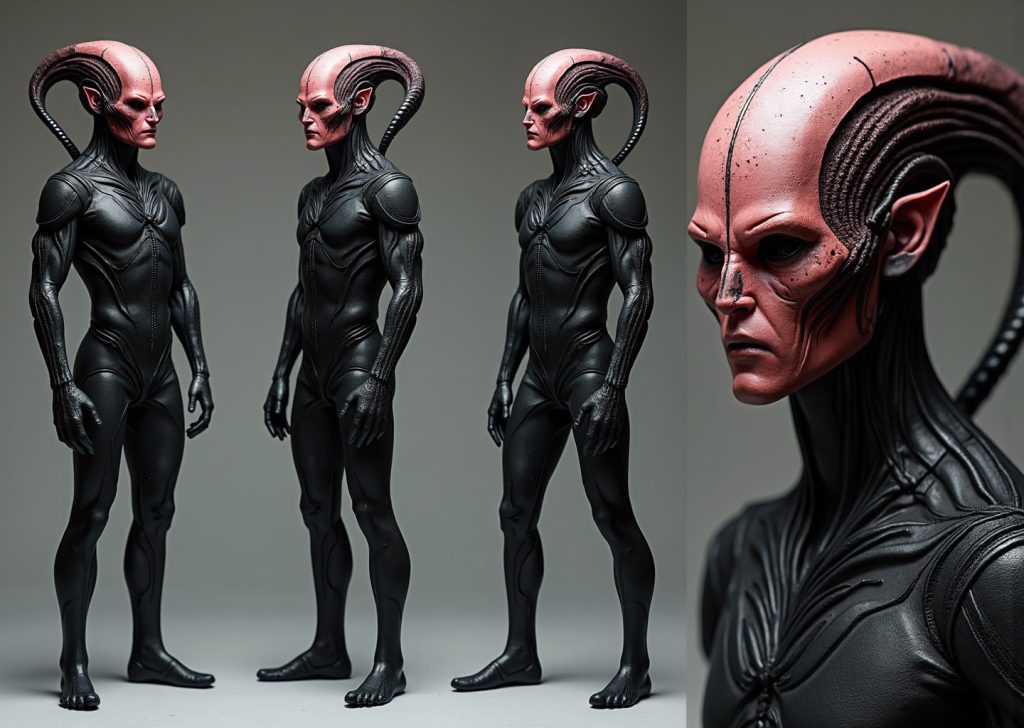
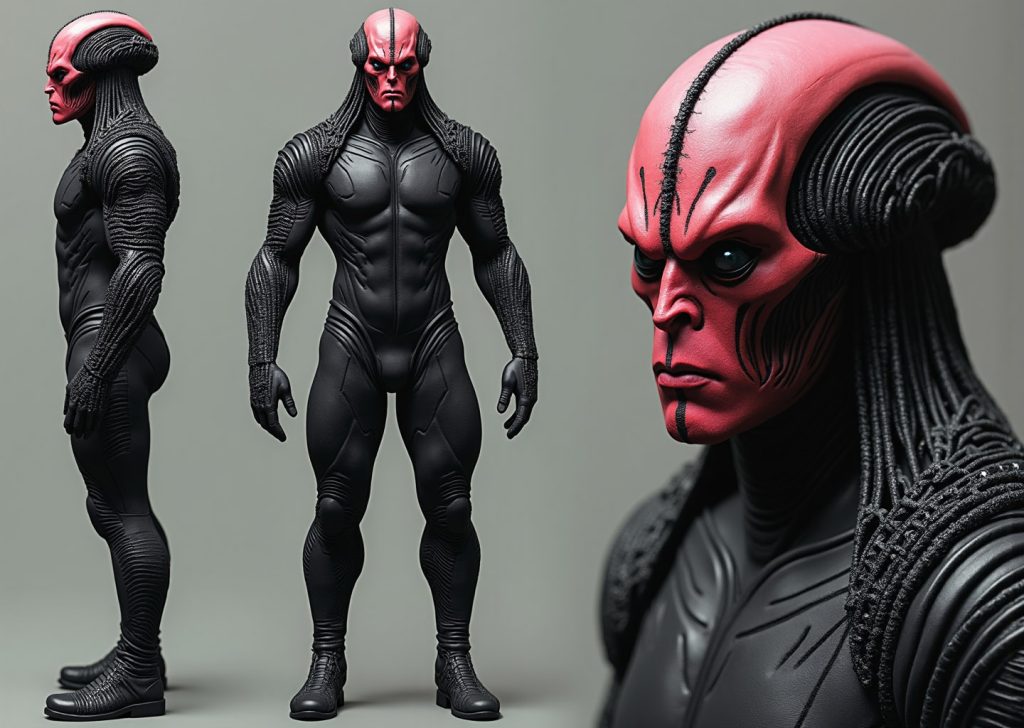


I may reuse a couple of those for Monitors from Parallel Worlds. Although I must admit that while the androgynous look works for some of them, it does not work for others.
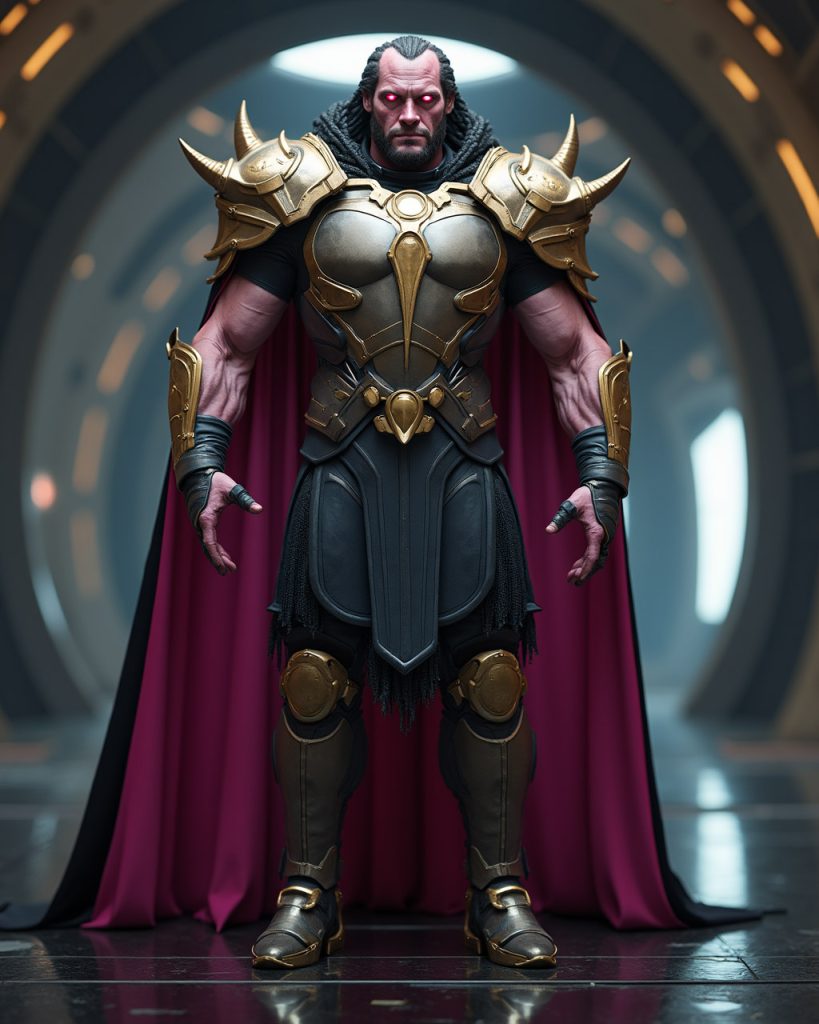
Eventually, I arrived at a permutation of that last one above but reintroduced some of the gold detailing from the Monitor’s Satellite. And ended up with this fellow:

I can’t quite put my finger on it, but that image feels like a character with a backstory—he seems to be carrying a weight and to have a presence.
I can see why AI image generation is so addictive. It is that “just one more” factor as you tweak prompts, try new seeds, and
-
Tolkien as the Unreliable Narrator

A video called “Why Lord of the Rings LIES to You” on the Hello Future Me YouTube channel got me thinking. It reminded me that J.R.R. Tolkien was using the trope of the Unreliable Narrator for his Legendarium. Tolkien was a philologist, an expert on languages and their history, who created Middle Earth as a vehicle for his constructed languages. His conceit was that he translated the Red Book of Westmarch, an account of the War of the Ring as written by Bilbo and Frodo. We even see that in the Lord of the Rings movies when Bilbo is seen writing his account while narrating the nature of the Hobbits.
I won’t recount here all the differences between the Peter Jackson version of Middle Earth and Tolkien’s original, other than to say that they did not have the full rights to all of the background material, made adjustments for the medium they were working in, and significantly extended the Hobbit (a single children’s story) into three full films. That isn’t even including the additional Battle for Middle Earth computer games and whatnot around the edges.
Given that Tolkien was an unreliable narrator and Jackson made changes, how do we regard Jackson’s relationship to the Red Book of Westmarch? Can we add to the Book’s own “history”
Professor Tolkien’s popular translation of the Red Book of Westmarch forces us to examine the history of that text in modern times. His working text, referred to in philologist circles as the Oxford Manuscript, has a rather storied origin that has been recounted at some length by Tolkien himself. In short, a version of the Red Book came into the collection of the Bodleian Libary, Oxford in the early 19th century, part of behest of books from the estate of extant West Country landowner. It languished there, miss-indexed, until the early-20th century when it was discovered by Professor Tolkien who then made it his life’s work to translate its hitherto unrecorded ancient languages.
Nevertheless, the Oxford Manuscript is not the only known manuscript of the Red Book. At least three other copies are known to exist. By far the most infamous of these is the Colonial Folio. British academic opinion holds that the Colonial Folio began as an abridged copy of the Oxford Manuscript which was translated into English by an unnamed scholar sometime prior to the 17th century (even Dee has been invoked as a possible scribe). It resurfaced in private hands in the late-19th century passing through the collections of several prominent American business tycoons before arriving into the bands of a reclusive Californian theme-park entrepreneur in the 1960s.
The original Oxford Manuscript is no longer believed to exist; it being destroyed during WWII in a fire started by Nazi bombing. The only records we have of it are Professor Tolkien’s own notes and translation. The Colonial Folio has not been seen publically since the early 1970s, although the adaptations produced by Peter Jackson and his circle are believed to based upon it.
Of intense interest to philologists are the other two known copies of the original text and of these, the Helena Manuscript is by far the most interesting. This text is believed to have been acquired by Helena, mother of Constantine the Great in the 3rd century AD. Copied were made in Constantinople and at least one made it into Cairo under the Abbasid Caliphate’s Translation Movement, c1000 AD. A copy, in Arabic, was made at that time. What is especially interesting is that the Helena Manuscript is believed to have contained an extensive genealogy of the Kings of the Haradrim, a discussion of their languages, and their own origins. A copy was reputed to have been seen in 17th century Syria.
-
Demographics of Fictional DC Cities
One of the biggest problems with DC’s fictional cities is that the big two always fight to make themselves the biggest. For example, both Metropolis and Gotham City are quoted with populations in excess of New York’s real-world population.
We can break it down further:
- Thematically, Metropolis and Gotham City echo New York, so it is reasonable to say that New York’s special status is lost in the DCU. Some part of NY’s population will have gone elsewhere. It is still a big city, just not the biggest.
- Economically, Gotham has more crime, which suggests a more depressed economy. That is less attractive to modern incomers.
- Gleaming Metropolis will look far more attractive. It should be a world leader, certainly the largest city in the “Western World.”
- Coast City exists but is not shown to eclipse Los Angeles, so it will be smaller.
- Central City with Keystone City are probably in the Philadephia/Phoenix range (large, but not big three).
Methodology
Realistically, these cities should follow something called Zipf’s law, a power-law scaling of city-size based on the city’s rank order. That says, if you rank the cities in a country by decreasing population (New York = 1, Los Angeles = 2, etc.), then their populations will be related by:
The population of City 2 = Population of City 1 * ( Rank of City 1 / Rank of City 2 )
Using this we can regenerate the populations of America’s top ten cities, including these four DC cities (Metropolis, Gotham City, Coast City, Central/Keystone). The trick is to pick a scaling that allows most cities to retain their approximate real-world population levels but does not make Metropolis (the Rank 1 City) stupidly large.
Results
The table below shows the ranked list of cities by population in the DCU. There are six real cities and four fictional ones. The columns “Real” and “Zipf” show the actual population of the real cities and their inferred population using the Zipf rule. The result is reasonably close, albeit with some scatter in the second significant figure.
The final column, “Fictional”, shows what we would infer about the cities if we included the four fictional ones. A population of 6.8 million in New York is down a bit, but this value allows the scale for the lower-ranked cities to remain relatively unchanged. Chicago is the break-even point. Any higher, Metropolis looks ridiculously large. As it is, at 13.6 million, Metropolis will be equal in size to Tokyo and will be about the 10th largest city in the World.
City Rank City Population [millions] Real Zipf Fictional 1 Metropolis 13.6 2 New York 8.49 8.16 6.80 3 Gotham City 4.53 4 Los Angeles 3.93 4.08 3.40 5 Chicago 2.72 2.72 2.72 6 Coast City 2.27 7 Houston 2.34 2.04 1.94 8 Central City/Keystone City 1.70 9 Philadelphia 1.56 1.63 1.51 10 Phoenix 1.54 1.36 1.36 The overall distribution seems fair, with Chicago coming out unchanged. New York is reduced, as it would always be, but the others seem to come out okay. The actual percentages we quote will depend on the maps we use.
Caveats
A more realistic way of doing this is to take the fictional maps of these cities, compute their area, and then assign a population density to each borough or district. The trouble with that is we often only have maps of the very centre of each city. Gotham is the poster child for this. We have the brilliant Brown map for Gotham’s core but know virtually nothing about its suburbs.
-
The effect of DC Cities
An interesting take on the DC Universe (“It’s not our Universe”) by Patrick H. Willems:
I’ll embed this here as a note to myself.