
Genghis Khan
Genghis Khan (1162-1227), born Temüjin near the Onon River in Mongolia, transformed from a tribal leader into the architect of history’s largest contiguous land empire. Legend claims his birth was marked by a blood clot clutched in his hand, an omen of future greatness in Mongol tradition. After a childhood marked by betrayal and hardship, he eventually built a following through a combination of military prowess and political innovation. By 1189, he had united several Mongol tribes, transforming bitter rivals into loyal allies through a mixture of force, diplomacy, and his revolutionary practice of placing competence above tribal affiliations. His formal proclamation as “Universal Ruler” at the kurultai of 1206 marked the birth of the Mongol Empire.
Vandal Savage has made claims to be the DCU Genghis Khan. Most comics show Genghis Khan as a distinct individual, but the Young Justice TV series leant heavily into the idea that Savage was Khan. We are keeping them separate.
Genghis Khan’s early campaigns focused on the Western Xia and northern China, but it was the execution of his trade delegation by the Khwarazmian Empire in 1218 that triggered his most dramatic conquests. His campaigns were marked by both exceptional brutality toward those who resisted and remarkable tolerance toward those who submitted. The Mongol advance displaced numerous populations across Central Asia, including the family of the future Ra’s al-Ghul, and reshaped the political landscape of medieval Asia.
Under his leadership, the Mongols developed sophisticated siege warfare techniques, a complex military organization based on units of ten, and an efficient relay messenger system that would later evolve into the Yam postal network. Despite his fearsome reputation in the West, Mongol histories paint a more complex picture of Genghis Khan as a lawgiver and reformer. He established the Yassa code of laws, promoted religious tolerance throughout his domains, and fostered international trade along the Silk Road.
The circumstances of his death in 1227, reportedly from injuries sustained in a horse fall, became shrouded in mystery. His burial site remains unknown, with legend claiming that a river was diverted over his grave, horses trampled all traces of the burial, and the slaves who dug the grave were killed to maintain its secrecy. Before his death, he established a clear succession by nominating his third son Ögedei as heir, though mandating a two-year mourning period that helped ensure a stable transition.
Immediate Descendants
This tree shows only those immediate descendants that have Codex entries.
Realworld Counterpart — This Codex Entry describes a fictionalized account of a real person, location, or event. More information about the real world version of this individual or topic can be found at the following resources:
Timeline for Genghis Khan
-
Historical Birth of Temüjin
Temüjin, the future Genghis Khan, is born near the Onon River in Mongolia.
-
Historical Ögedei Khan is born
Ögedei Khan, the third son of Genghis Khan (24) and Börte Ujin, is born in Mongolia.
-
Historical Rise of Temüjin
Temüjin (27) unites several Mongol tribes and becomes the leader of his clan, starting his campaign to unify the Mongol people.
-
Historical Tolui is born
Tolui, the third son of Genghis Khan (29) and Börte Ujin, is born in Mongolia.
-
Historical Empire's Birth
Temüjin (44) is proclaimed “Genghis Khan,” or “Universal Ruler,” at a kurultai (council), formally establishing the Mongol Empire. He proceeds to radically reshape Mongol society from a tribal basic to a true meritocracy.
-
Historical Western Xia Falls
Genghis Khan (47) conquers the Western Xia in northwestern China (one of the three main divisions of China at that time).
-
Historical Mongol Catalyst
Muhammad II of the Khwarazmian Empire has a peaceful trading delegation from the Mongols killed. Genghis Khan (56) takes this as a casus belli and launches a campaign westward.
-
Historical Fall of Bukhara
Genghis Khan (58) and the Mongols overwhelm the city of Bukhara killing 20,000 of its defenders. Khan tells the civilian population that “I am the punishment of God”.
-
Historical Marriage of Genghis Khan and Börte Ujin
Confirming an arrangement that had been made by their families when they were children, Genghis Khan (59) marries Börte Ujin.
-
Historical Death of Genghis
Genghis Khan (65) dies from wounds received after falling from his horse. Before his death, he nominates his third son Ögedei Khan (41) as his successor. However, his youngest son, Tolui (36), serves as a regent until Ögedei’s succession is confirmed.
| Genghis Khan | |
|---|---|
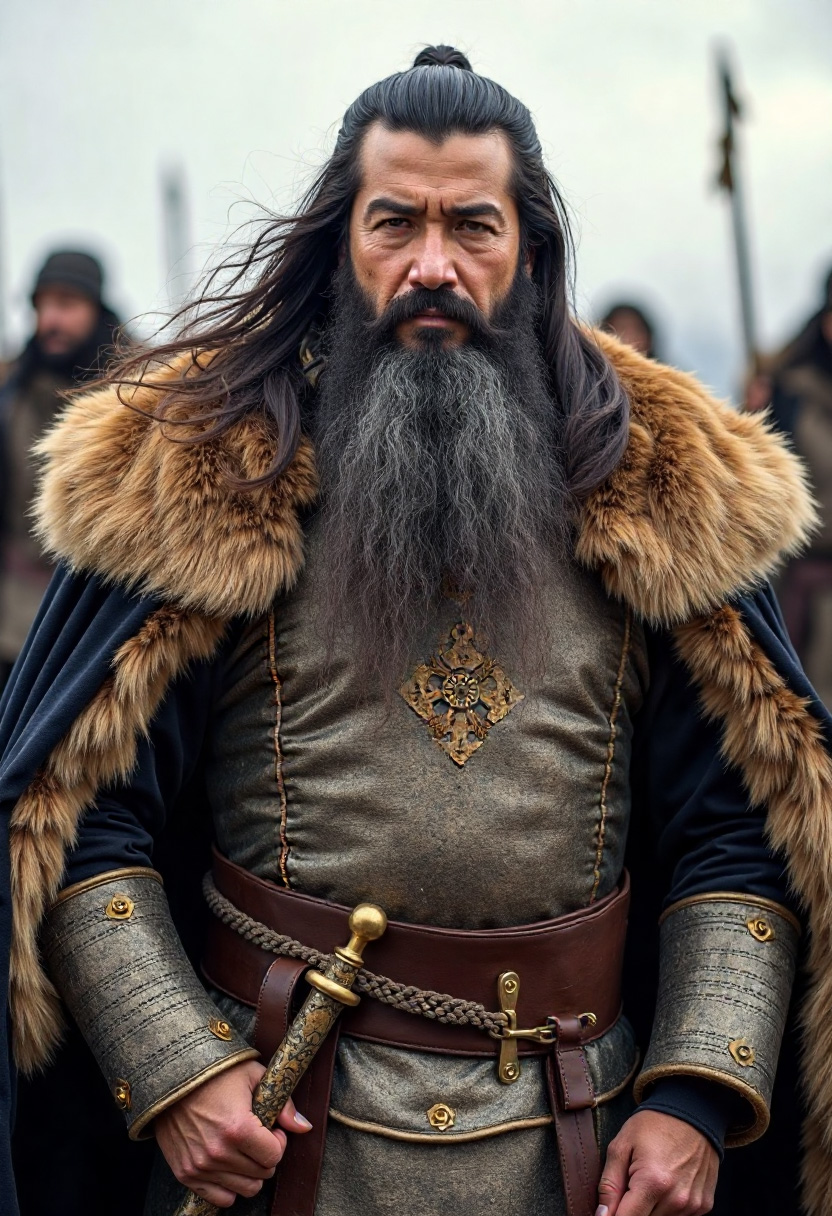 | |
| Mongol Empire | |
| Reign | 1206 AD – 1227 AD (Empire founded, first Great Khan.) |
| Predecessor | Empire founded, first Great Khan.. |
| Successor | Tolui |
| Biographical Data | |
| Species/Race | Human |
| Gender | Male |
| Born | 1162 AD Khentii Mountains |
| Died | 1227 AD (aged 65) China (Fallen from horse) |
| Family | |
| Spouse | Börte Ujin (m. 1221 AD) |
| Children | Ögedei Khan Tolui |
| Father | Yesygei |
| Mother | Hö’elün |
| Affiliation | |
| Allegiance | Mongol Empire |
| Religion | Tengrism |
Leave a Reply